




General Anesthesia and Nerve Blocks

General Anesthesia and Nerve Blocks

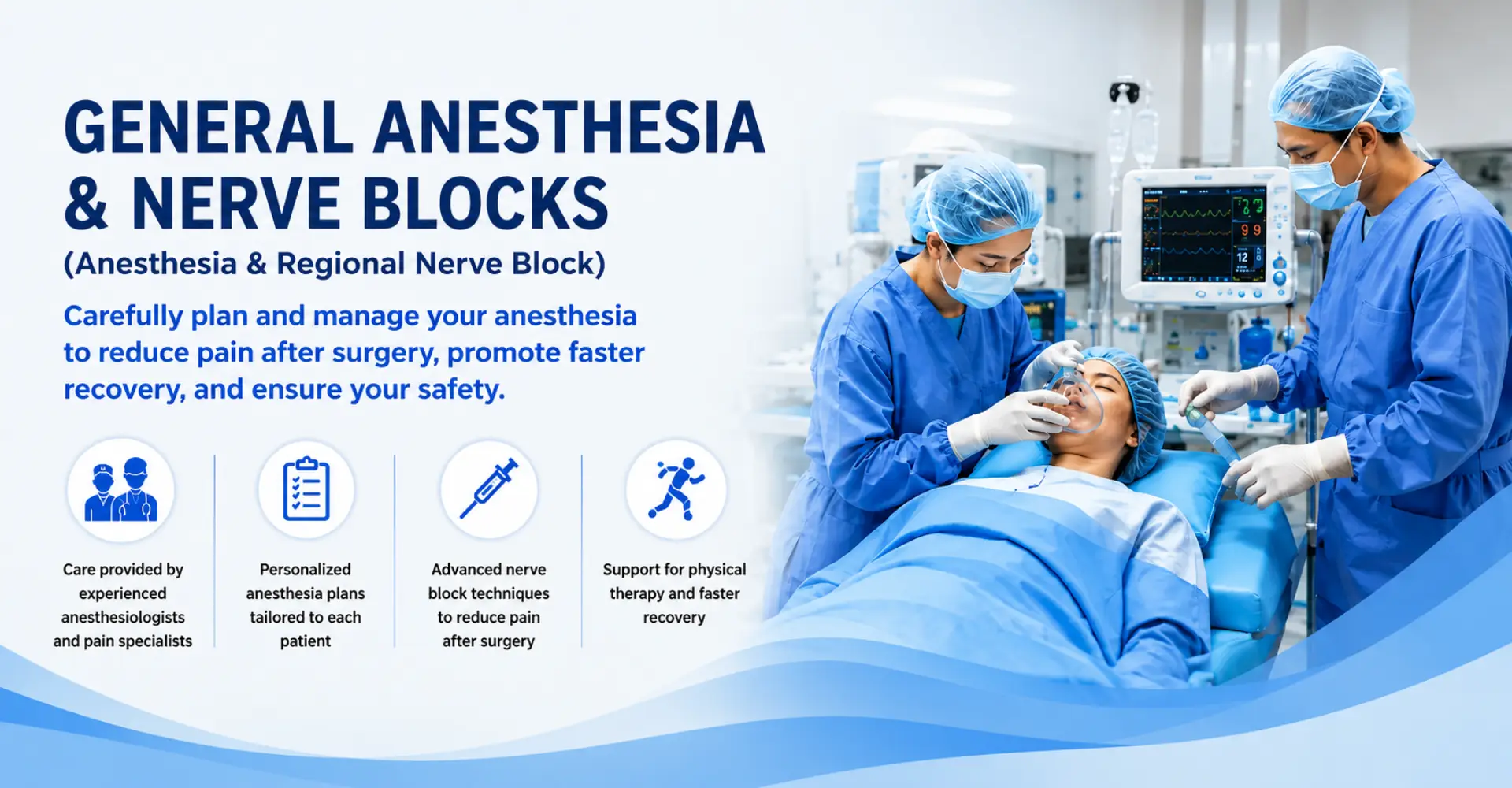
For safe and effective surgery, the anesthesiologist and nurse anesthetist team play a crucial role in ensuring that the procedure runs smoothly and that pain is effectively managed. The choice between general anesthesia, intubation, or spinal anesthesia has different advantages and considerations. The appropriate approach can be carefully planned and decided together by the medical team and the patient. In addition, the team’s regional nerve block techniques can help reduce pain after surgery, allowing patients to start physical therapy sooner and leave the hospital earlier.

Frequently Asked Questions

Before surgery, the anesthesiology team will assess the patient’s overall health and develop an appropriate anesthesia plan to reduce risks and improve safety during surgery.
The medical team will explain the benefits and limitations of each option and work with the patient to determine the most appropriate method.
A nerve block can reduce pain after surgery, decrease the need for pain medication, and allow physical therapy to begin sooner.
Most patients will begin to regain consciousness shortly after surgery and will be closely monitored by the anesthesiology team and nurses.
The doctor will consider the type of surgery, the patient’s health, and individual suitability before deciding whether a nerve block is appropriate.
No. The effect of the medication gradually wears off over time, and normal movement returns once the medication has worn off.

Plan Your Treatment with Confidence, Supported by a Medical Team Throughout Your Care.

From preoperative assessment and selecting the appropriate anesthesia technique, to intraoperative care, pain management, and postoperative recovery, our medical team works together to develop a treatment plan tailored to each individual patient.

Medical Team

นพ. ปรัชญ์ กำลังสินเสริม

Prach Kamlangsinserm, M.D.

Orthopedic Surgery Specialized in Arthroscopic Surgery
Doctor’s Profile +
นพ. พัลลภ ถิระวานิช

Panlop Tirawanish, M.D.

Orthopedic Surgery Specialized in Endoscopic Spine Surgery
Doctor’s Profile +
พญ ชุติมา ลีวัชรารุ่งเจริญ

Chutima Leewatchararoonjaroen, M.D.

Anesthesiologist Specialized in Regional Anesthesia
Doctor’s Profile +

Health Articles

Is Joint Cracking or Popping Dangerous?

Is Joint Cracking or Popping Dangerous?

The “cracking,” “popping,” or “clicking” sounds you hear when moving a joint are very common and do not necessarily mean that you have osteoarthritis. These sounds may be caused by changes in pressure within the joint fluid, the movement of tendons or ligaments, or friction between structures inside the joint. However, if joint noises occur…


อ่านเพิ่มเติม +
Does Running Cause Knee Osteoarthrites?

Does Running Cause Knee Osteoarthrites?

Many people worry that running regularly may cause knee osteoarthritis to develop faster. However, the reality is that running at an appropriate level, combined with proper physical preparation, does not necessarily lead to knee degeneration. In fact, appropriate exercise can help strengthen the muscles around the knees and maintain a healthy body weight, both of…

อ่านเพิ่มเติม +
What Causes Inner Knee Pain?

What Causes Inner Knee Pain?

Inner knee pain can occur for many different reasons. In older adults, it is often associated with medial compartment knee osteoarthritis, which is more common in people with bow legs or excess body weight. These factors can increase pressure on the inner surface of the knee joint. In working-age adults and athletes, sudden inner knee…

อ่านเพิ่มเติม +